
Review · TICKETS
Milan: San Sepolcro Crypt Skip-the-Line Entry Ticket
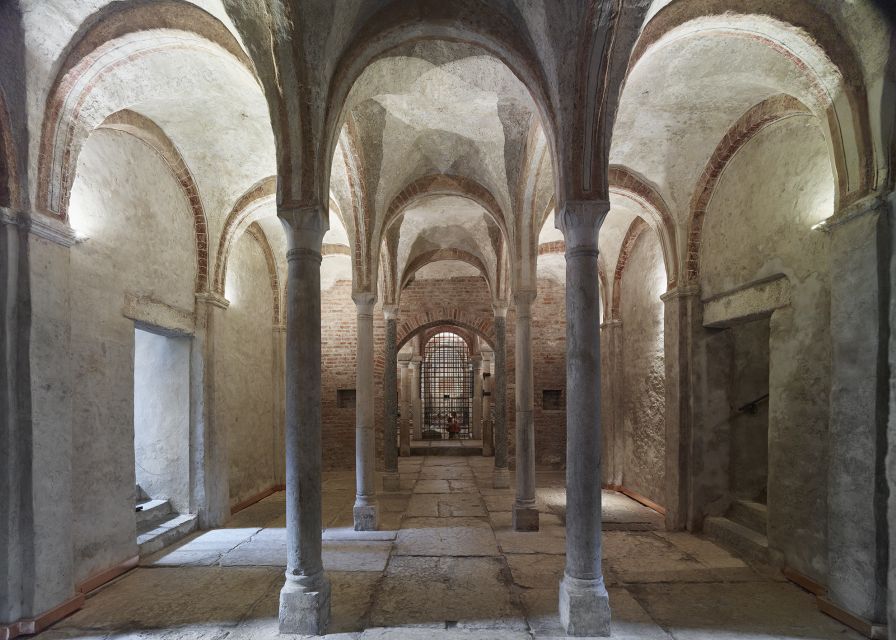
Step underground in Milan and time slows down. The San Sepolcro Crypt is one of those places that makes the city feel older than you expect, built entirely underground on the footprint of the ancient Roman forum area of Mediolanum.
I like that this ticket is built for speed, so you spend less time fussing and more time looking closely. I also like the “layers” effect: recently restored frescoes and medieval vaults sit right alongside physical reminders of Roman civic life.
The main drawback is size and pacing. Even though it’s sold as a 30-minute visit, the crypt is compact, so if you expect a big, room-after-room attraction, you may feel you used the time too quickly.
Quick hits before you go
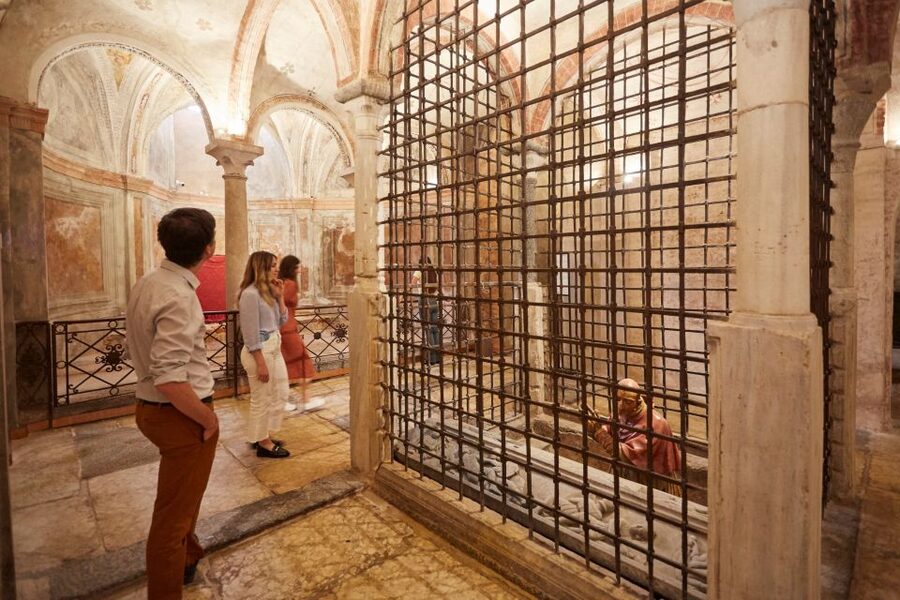
- All-underground church setting: you walk into a medieval space where the ceiling, light, and silence feel naturally cocooned
- Roman forum connection: the site sits where Mediolanum’s civic and religious center once was
- Restored 1200-era and 13th-century details: frescoes and vault decor have been brought back to a clearer look
- Verona stone paving you can walk near: slabs tie the present to the ancient street levels
- A short, focused visit: 30 minutes is usually enough if you keep your eyes on the main sights
Finding the Crypt entrance at Piazza San Sepolcro
The entrance is in Piazza San Sepolcro, and that matters because the crypt is not at a grand street-level facade. To get there smoothly, head to the courtyard where the exit of the Pinacoteca Ambrosiana is located.
From there, look for the statue of Federico Borromeo. Next to it, you’ll find a staircase that leads down to the crypt entrance. It’s a simple route, but it can be easy to miss if you arrive late or wander the wrong side of the courtyard.
I’d suggest you plan to arrive a few minutes early and get your bearings before your scheduled entry window. Also, be aware that strollers are not allowed, so travel light if you’re coming with kids.
A few more Milan tours and experiences worth a look



What you really see in 30 minutes underground
This experience is centered on one core idea: the crypt lets you read Milan like a timeline written in stone. You come down into a medieval underground church founded in 1030 A.D. That date alone puts you in a different mental frame. Then the space confirms it.
You’ll walk through the church and take in the key visual anchors:
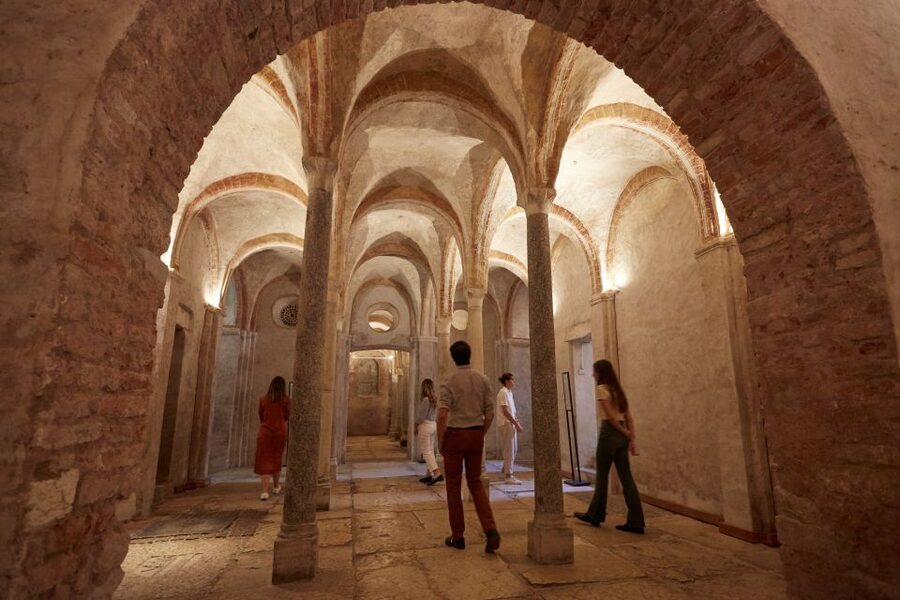
- the medieval vaults and their decor
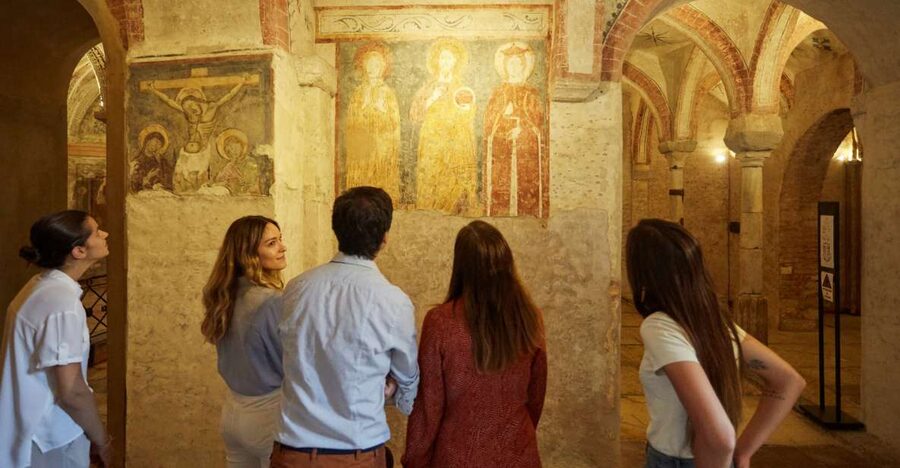
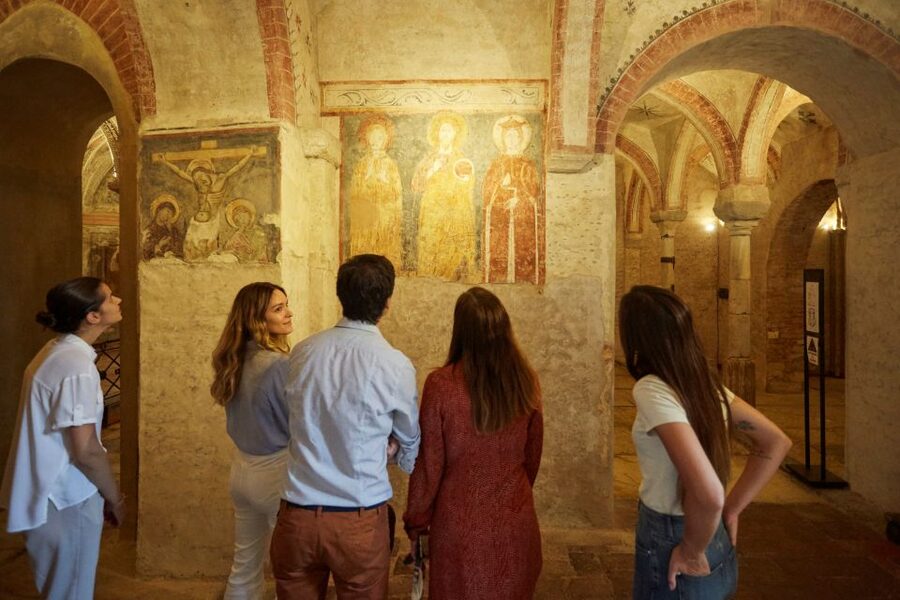
- the frescoes (with a restored look)
- the paving made of large slabs of white Verona stone
The “wow” moment usually comes from the feeling that the crypt is not a museum display. It feels like you’re stepping into a functional sacred room that just happens to be historic. The ceiling lines, the underground layout, and the preserved surfaces all contribute to that effect.
Also, you’re not only looking at medieval art. The site is described as the location where the Roman forum of Mediolanum once stood. That turns your attention outward too, even while you’re standing still. When you notice the stonework under your feet and along the walkway, it starts to feel like you’re physically near the ancient urban ground level.
The Roman forum connection, and why it’s more than a trivia point
Milan’s appeal is not just that it has Roman remains. It’s that the city grew on top of itself. Here, the connection is direct: this crypt is built underground on the place where the Roman forum for ancient Mediolanum was located.
So when you walk through the crypt, you’re not only admiring medieval religious architecture. You’re also standing near the concept of where civic life happened: public gatherings, major religious activities, and the big moments of daily importance for Roman civilians.
The paving detail makes that connection tangible. The crypt includes large slabs of white Verona stone said to come from the pavement of the old Roman forum. The description also notes that this forum-level material fascinated Leonardo da Vinci, with the forum dating back to the 4th century.
Even if you don’t come for Leonardo, you’ll appreciate why this matters. It’s one thing to read about Rome in a book. It’s another to see, under a later church, something that links to the kind of street where people actually walked and conducted their lives.
Frescoes and vaults: what restored medieval art means here
A big reason to choose this ticket is the focus on recent restoration. The crypt is known for its recently restored frescoes and vault surfaces with medieval late 13th-century decor.
In practical terms, restoration changes what you can see. Paint that has faded, been covered, or been less legible over time can become clearer again, and that affects your experience. Instead of “I think I see shapes,” you can spend more time noticing the themes, the colors, and the way the artwork wraps with the architecture.
The vaults are especially important in underground spaces. Vaults shape your view, almost like a ceiling-level “canvas” that carries the mood. Here, that medieval late 13th-century decoration helps the crypt feel complete, not like a bare basement church. You get a stronger sense that this was a cared-for sacred setting.
And the frescoes are not just decoration either. They reinforce the crypt’s function as a deeply sacred atmosphere, not a casual photo stop. If you’re the kind of person who enjoys looking slowly at religious art, this is where your time will go fastest, in a good way.
The pavement moments, and how to make them count
One of the most memorable parts is the walk along the pavement of old stone that’s associated with the Roman forum. You’re essentially getting a visual bridge between:
1) the underground medieval church experience, and
2) the earlier Roman urban ground level beneath and around it
The paving is described as large slabs of white Verona stone, coming from the Roman forum pavement. That gives you something specific to focus on instead of wandering room to room.
Here’s how to make this section more satisfying:
- Pause where you can see the texture and the edges of the slabs
- Look for how the walkway channels you through the space
- Take a moment to think about what kind of foot traffic this might have seen in earlier centuries
If you rush, you’ll miss the point. But if you slow down for a couple of short pauses, the pavement becomes a highlight, not just background.
A few more Milan tours and experiences worth a look



Skip-the-line value: what you’re buying with an €? no, this is dollars ticket
The price is listed at $11 per person. For Milan, that’s a very reachable number, especially because the experience is tightly timed.
You’re not paying for an all-day attraction. You’re paying for a short, concentrated entry into a site that would otherwise be harder to fit into a normal sightseeing day. The skip-the-line ticket matters because underground sites can have slower entry flow. When you’re only there for about 30 minutes, losing time to a lineup is the kind of annoyance you do not need.
Value-wise, this ticket works best if you want:
- a low-cost historic stop
- a unique architectural setting (entirely underground)
- restored fresco and vault details that reward close looking
If you’re the type who needs a long visit to feel satisfied, you might find the time short. But for a focused history fix, $11 feels fair.
Timing and expectations for a compact crypt
This is a 30-minute experience. That sounds like a lot until you’re inside. The crypt is described as compact, and the layout is more corridor-like and room-like in a focused way rather than a sprawling multi-gallery circuit.
So plan your expectations like this:
- Give yourself time to look at frescoes and vaults. That’s where most of the attention goes.
- Accept that the crypt is not a giant site. If your main goal is to see everything end to end, you probably won’t need anywhere near 30 minutes to finish the core highlights.
If you enjoy quick, high-impact stops between bigger attractions, this works beautifully. If you’re hoping for a long, meandering “hidden world” experience, you may feel like you’re done sooner than you expected.
Who this is best for, and who should skip it
This visit is a good match for you if you like:
- history that feels physical, not just informational
- underground architecture and sacred interiors
- Milan’s Roman-to-medieval layering, especially the Mediolanum forum link
It can be less ideal if you:
- need wheelchair access, since it’s noted as not suitable for wheelchair users
- rely on baby strollers, since baby strollers are not allowed
For families, the lack of stroller access is the bigger limiter. For seniors who walk comfortably, the short time window can be a plus. For art lovers, the restored fresco and vault decor are the selling point.
A quick heads-up based on real-world friction points
Two issues come up often when you do small timed experiences like this.
First, the meeting point is precise. The entrance is in Piazza San Sepolcro, down a staircase next to the Federico Borromeo statue in the courtyard by the Pinacoteca Ambrosiana exit. If you show up late or from the wrong side of the courtyard, you can waste time when you least want to.
Second, compact sites can create expectation mismatch. If you’re the type who expects a bigger “show,” you might feel you got less than you hoped for. If you expect a short, concentrated look at frescoes, vaults, and Roman paving connections, you’ll likely feel it was worth your time.
Should you book the Milan San Sepolcro Crypt skip-the-line ticket?
Book it if you want a short, solid history stop that combines an underground medieval church, restored frescoes and vaults, and a clear Roman forum connection to Mediolanum. At $11, it’s easy to justify when you like authentic, close-up sightseeing.
Skip it if you need a long, multi-room adventure or if you require wheelchair-friendly access. Also think twice if you hate timed, compact experiences, because you’re going for quality viewing, not hours of wandering.
If your goal is to add one genuinely unusual Milan stop, this is a strong choice.
FAQ
Where is the Crypt entrance and meeting point?
The entrance is in Piazza San Sepolcro. Go through the gate of the courtyard where the exit of the Pinacoteca Ambrosiana is located. Next to the statue of Federico Borromeo, a staircase leads down to the crypt entrance.
How long is the visit?
The duration is 30 minutes.
Is this ticket skip-the-line?
Yes. The included ticket is a skip-the-line entry ticket.
What is included with the ticket?
You get the skip-the-line entry ticket.
How much does it cost?
The price is listed as $11 per person.
What time period does the underground church date to?
The medieval underground church is founded in 1030 A.D.
What Roman location is the crypt associated with?
The church is built on the place where the Roman forum of the ancient city of Mediolanum once stood.
Are baby strollers allowed?
No, baby strollers are not allowed.
Is the crypt suitable for wheelchair users?
No, it is not suitable for wheelchair users.
Who operates or provides the experience?
The experience provider is Veneranda Biblioteca Ambrosiana.
More Skip the Line in Milan

More Tickets in Milan

More Tour Reviews in Milan



Not for you? Here's more nearby things to do in Milan we have reviewed











Tickets, compared.
 ★ 4.6Cathedral and Duomo’s Terraces Entrance TicketFrom $3061,054 reviews
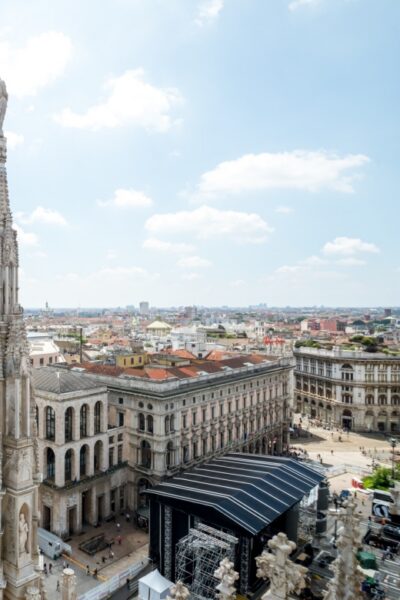 ★ 4.6Milan Cathedral: Duomo Terraces Ticket (No Church Access)From $226,111 reviews
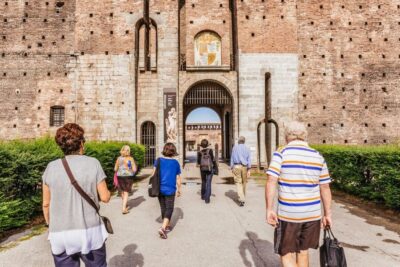 ★ 4.7Guided Walking Tour & Last Supper Visit with TicketFrom $1015,409 reviews
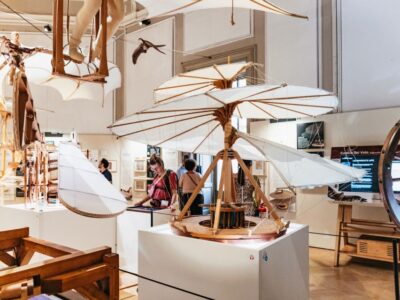 ★ 4.4Leonardo3 The World of Leonardo Museum Entry TicketFrom $183,241 reviews
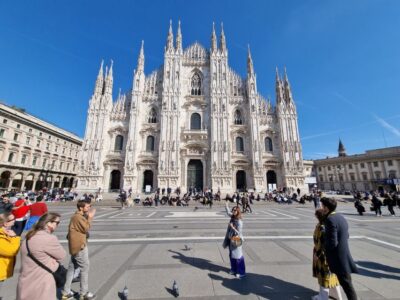 ★ 4.8Duomo Rooftop and Cathedral Guided Tour with TicketsFrom $572,678 reviews
 ★ 4.0Sforza Castle Entry Ticket with Digital Audio GuideFrom $152,675 reviews
 ★ 4.5Historic Milan Tour with Skip-the-Line Last Supper TicketFrom $1111,976 reviews
 ★ 4.6Last Supper Entrance Ticket and Guided TourFrom $881,792 reviews
Browse the lists this tour appears in