
Review · FULL-DAY
From Milan: Discover Florence & Pisa on an Exciting Full-Day Tour
Florence and Pisa in one day can be magical. This Milan day-trip strings together the big hitters with bilingual commentary and built-in free time. It is not a slow, relaxed stroll, but it is a smart way to see two icons without changing cities.
I love the English-and-Spanish live commentary on the train. You get context while you are traveling, so Florence and Pisa make more sense the moment you arrive. I also like that the tour leader gives bilingual guidance in the cities, which helps when you are trying to navigate crowds and keep moving.
The main thing to consider is the pace. The schedule is tight, and there is a lot of walking, so it is not the best fit if mobility is an issue or if you hate rushing between stops.
What makes this Florence and Pisa day-trip tick
- Bilingual live commentary on the train keeps the whole day from feeling like a checklist
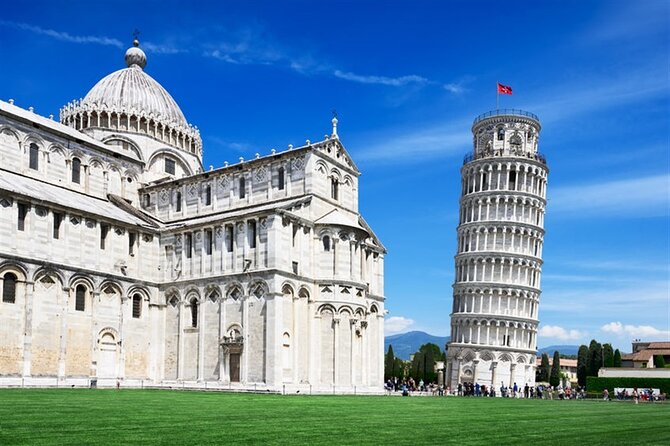
- Pisa is condensed on purpose, about an hour in Piazza dei Miracoli for photos and quick meaning
- Florence stops are short but strategic, like the fast intro at Santa Croce and longer wandering time at Piazza del Duomo
- Small group size up to 30 makes it easier to stay together than big-bus tours
- Optional Florence audio guide helps you keep exploring at your own speed
Price and value: what $203.30 covers (and what it does not)
At $203.30 per person, this is a mid-range day-trip price. The value is in the structure: train travel between Milan and the region, transport from the meeting point, and guided explanations in both cities. You are also paying for time saved, since the day is designed so you are not piecing together trains and local transit yourself.
What is not included is as important as what is included. Lunch is not included, so you will want to plan for food on your own in Florence or grab something quickly during free time. Also, the tour does not offer hotel pickup, so you will start at the official meeting point in Milan and keep that cadence all day.
A few more Milan tours and experiences worth a look
The 7:00 am Milan start, and why the train ride matters
You start at 7:00 am at Terrazza Gallia, Piazza Duca d’Aosta 9, right by major public transport. That early kick is part of the trade-off: you gain enough daylight to hit Florence and Pisa, but you also lose the luxury of sleeping in.
The train ride is not just transit. The tour includes live commentary on the train in English and Spanish, so your first real moments are guided, not blank. Even if you are not a “lecture” person, that context tends to make the monuments feel less random when you step off the train.
And if your group size ends up requiring it, ground travel between points may shift to a bus. That is noted as a possibility, so the day may feel a bit more “get there, move on” depending on group flow.
Florence stop 1: Piazza Santa Croce in 10 minutes
Your first Florence stop is Piazza di Santa Croce, centered on the Basilica di Santa Croce. This church is famous for its Gothic architecture and for being the final resting place of major Italian figures like Michelangelo, Galileo Galilei, Niccolò Machiavelli, and Dante Alighieri.
Ten minutes sounds short, and it is. But in a tight itinerary, this is a smart way to ground the day. You get instant historical gravity, then you move on before the crowds swallow all your time.
Tip for making it work: when you have a short stop like this, focus on the façade and the square itself, not trying to see every corner inside. If you later want more, Florence is full of ways to extend your interest on your own.
Piazza del Duomo free time: seeing Florence without bottling it up
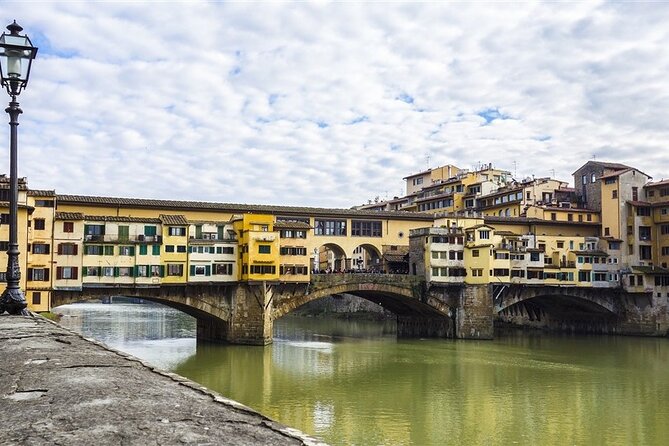
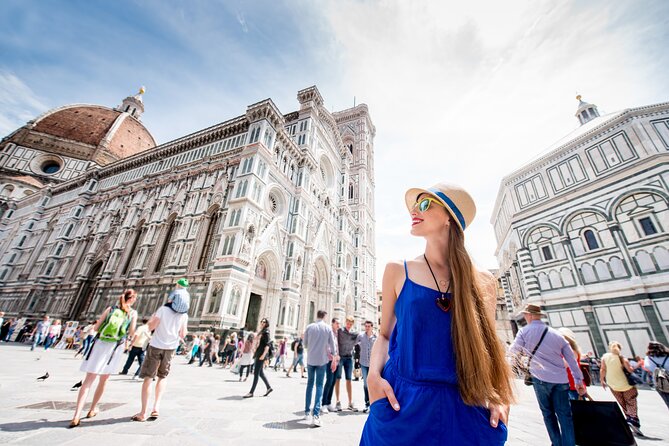
Next comes Piazza del Duomo, Florence’s main square with major landmarks clustered around it. This is where the Cathedral of Santa Maria del Fiore and Giotto’s Campanile frame your photos. There is about an hour of free time, which is the right amount for walking, looking up, and finding your bearings.
This is also where crowd reality kicks in. Florence is popular, and the square area can get packed. The upside is you can treat it like a home base: pause for pictures, check out the architecture from different angles, and then decide what you want to emphasize later when the guided stops are finished.
Try to use your hour like this:
- Walk a loop around the main views
- Stop for photos when you see a clean line to the dome and bell tower
- Save your deeper explorations for your own pace, since your schedule elsewhere stays tight
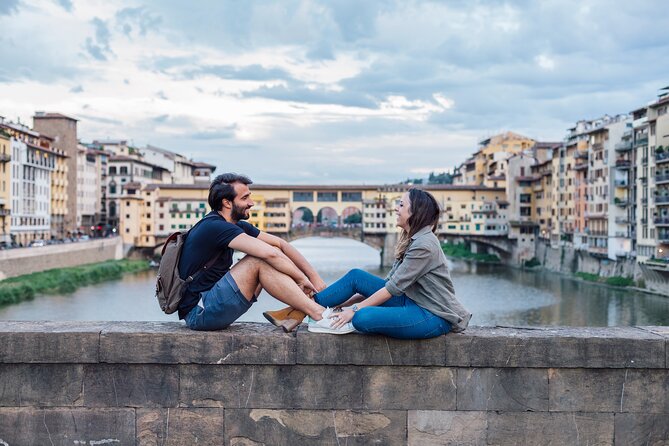
Ponte Vecchio: the shop bridge you can read like a street
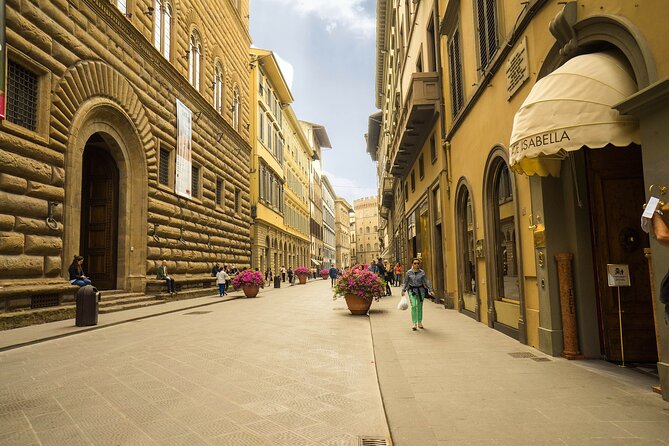
You will walk over the Ponte Vecchio, famous for the shops that line both sides. This bridge is not just a pretty photo spot. Historically, it was used by merchants, especially jewelers and goldsmiths, which helps explain why the buildings feel permanent and purposeful rather than temporary.
What I would watch for during your walk: look up and along the structure. The tents are suspended over the river and supported by columns, which is one of those practical details that makes the bridge feel engineered, not random. If you zoom in mentally on the function, the famous look makes more sense.
Even if you are not a shop person, Ponte Vecchio is still worth your attention. It is a living snapshot of how trade shaped city life.

A 15th-century Dominican church stop: what to look for in the frescoes
One of the stops is a 15th-century Dominican church described as spectacular, with frescoes by Gothic and early Renaissance masters. That tells you the emphasis: this is a “look for art details” stop, not a quick scenery glance.
Because no specific name is given for this stop, your best strategy is to treat it like a guided art moment:
- Notice how the frescoes relate to the church space
- Look for the change between Gothic and early Renaissance styles
- Take in the overall visual impact first, then return to specific scenes
The drawback? This sort of stop is easy to rush through if you treat it like a photo-only stop. With the day already packed, make a choice to spend a bit longer just observing, even if you skip additional angles.
Piazza della Signoria: where Florence’s civic power still feels present
Next you are in Piazza della Signoria, described as the seat of civil power with the Old Palace, and the heart of the city’s social life. This square is a great example of why Florence feels different from many Italian cities. It is not only about churches and art, it is also about civic space, public decisions, and street-level drama.
Your time here is a chance to reset your head between landmarks. Instead of thinking “what year is this,” think “how does a city run.” Florence’s public squares helped shape that.
If the square is crowded, do not fight the crowd for the perfect photo from the front. Use the edges. You can still frame the square’s scale and buildings without being stuck in one spot.
Il Duomo views: the dome story and why Brunelleschi still matters
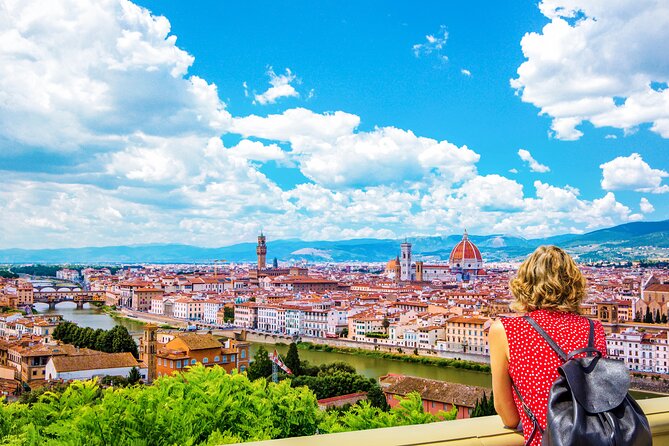
You will also see Florence’s cathedral referred to as Il Duomo, with a focus on its iconic dome designed by Filippo Brunelleschi. The description highlights the red-tiled dome and the marble façade, plus Giotto’s bell tower.
This is valuable even if you are not going inside, because the dome is the visual anchor of Florence. It is the kind of thing that is hard to appreciate from a distance until you see it at real scale and from a few angles.
One practical thing: because your day is tight, treat this as a “get the look, learn the why, move on” moment. If you try to turn it into a full cathedral visit, you will start sacrificing time elsewhere, including Pisa.
Pisa in one hour: Piazza dei Miracoli and the leaning-tower photo plan
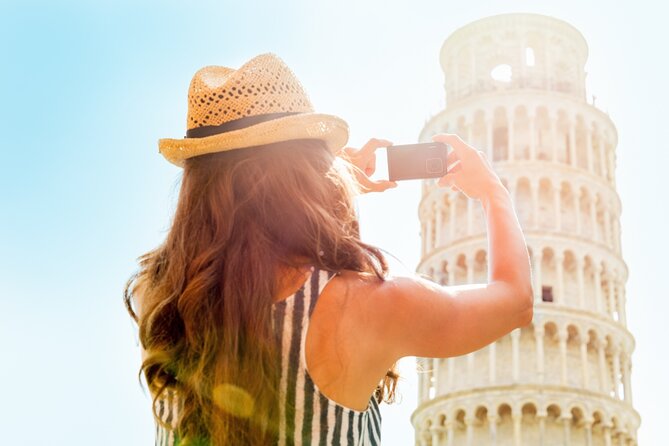
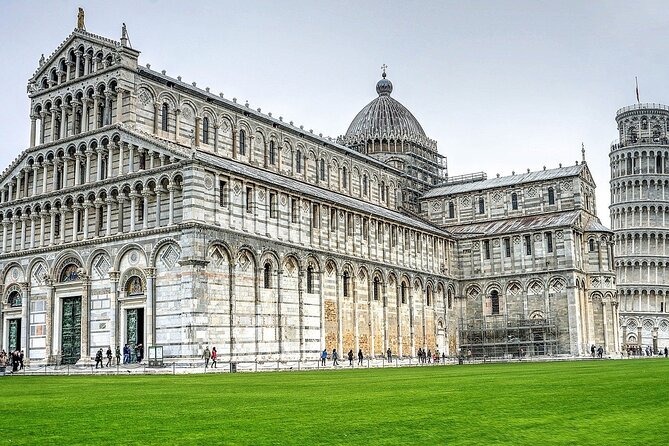
Then you head to Piazza dei Miracoli in Pisa. This is the area with green spaces, and the main showpieces: the leaning tower and the majestic cathedral of Pisa with marble bands. You get about one hour of free time, and yes, it is built for funny pictures.
The leaning tower story gets mentioned in the flow of the day: it started leaning one way and then continued to lean in the opposite direction. That’s the kind of detail that turns a photo from “I was there” into “I get what I am looking at.”
Also included in the time area is the Cathedral of Santa Maria Assunta, the medieval Catholic cathedral dedicated to the Assumption of the Virgin. It is also described as the episcopal seat of Pisa.
The key way to set your expectations: Pisa is rewarding, but it is compact. You should focus on the main rectangle of sights around Piazza dei Miracoli, not trying to explore the wider city unless your schedule stretches.
Audio guide option in Florence: when it is worth it
If you choose the Florence audio guide option, you will get instructions to download it after booking confirmation. The audio guide needs an Android smartphone (version 5.0 and later) or iOS, and it is not compatible with Windows Phones or older Apple devices listed in the details. You will also need an internet connection to download it on the bus.
Is it worth it? If you like having historical context in your ear while you look around, yes. The biggest benefit is flexibility, since you can pause or replay. If you are the type who prefers to stay fully in the guide’s flow, you might skip it and just rely on the tour leader.
Headphones are recommended. For a day like this, you will be happier if you can listen without sharing one earbud.
Practical tips for a tight 15-hour schedule
This is a long day, about 15 hours. You are moving from Milan to Florence to Pisa and returning by the end of the day, so your “comfort choices” matter.
Here are the practical moves that help most:
- Wear shoes you can walk in for hours. The itinerary is described as demanding, with great distances in the cities.
- Bring a refillable water bottle if you can. Lunch is not included, and you will want something between stops.
- Plan to use your free time strategically. In Florence you get an hour in Piazza del Duomo, but other stops are shorter.
- Don’t expect slow museum pacing. This is a “see it, understand it, keep going” style tour.
- If you have mobility challenges, think carefully. The tour is not recommended for people with mobility problems due to pace and walking distances.
One more reality check: group maximum is 30 travelers. That is not huge, but even with a smaller group, popular areas like Florence’s center can feel crowded. Your best tool is mental flexibility, accept crowd speed, and keep moving with the plan.
Should you book this Florence and Pisa tour?
Book it if you want a structured day that covers the must-sees fast, and you like having explanations delivered in English and Spanish so the monuments feel connected. You will get the best value if you are comfortable walking, you are okay skipping long sits and museum deep dives, and you want the payoff of seeing both Florence and Pisa without the hassle of organizing transport on your own.
Skip it or reconsider if you are looking for a relaxed pace, you need lots of downtime, or you are concerned about mobility. Also, if you dislike itinerary risk, understand that this kind of train-based day can be affected when rail operations change, because the flow depends on transit timing.
If you fit the first group, this is a strong way to spend a single day getting a “greatest hits” taste of Tuscany, with enough structure to make it feel more than just photos.
FAQ
What is the tour duration?
The tour runs for approximately 15 hours.
What time does the tour start in Milan?
The start time is 7:00 am.
Where do we meet in Milan?
The meeting point is Terrazza Gallia, Piazza Duca d’Aosta, 9, 20124 Milano MI, Italy. The tour ends back at the meeting point.
Is lunch included?
No, lunch is not included.
Is the tour commentary available in English?
Yes. There is live commentary in English (and also Spanish).
Is there an audio guide for Florence?
An audio guide in Florence is available if you select that option. You will need a compatible Android or iOS smartphone, and you will need internet access to download it on the bus.
Are children required to have a car seat?
Children under 11 must sit on a baby car seat. Amigo Tours cannot provide it, so you need to bring your own.
Is hotel pickup included?
No. Pick up in hotels is not included.
Is the tour refundable?
The tour is non-refundable and cannot be changed for any reason, because train tickets are purchased.
More Full-Day in Milan
More Tours in Milan
More Tour Reviews in Milan
Not for you? Here's more nearby things to do in Milan we have reviewed





Full-Day, compared.
 ★ 4.3Cinque Terre Full-Day Guided Trip With CruiseFrom $157644 reviews
 ★ 4.0From Milan: Cinque Terre Guided Full-Day Trip With CruiseFrom $169559 reviews
 ★ 4.5From Milan: Genova & Portofino Full-Day TourFrom $134333 reviews
 ★ 4.5From Milan: Venice Full-Day Guided Tour With Boat RideFrom $204322 reviews
 ★ 4.7From Bergamo: Verona and Sirmione Full-Day TourFrom $105309 reviews
 ★ 4.5Bellagio & Varenna Full-day Tour on Lake Como by private boatFrom $453301 reviews
 ★ 5.0Full-day Skip-The-Line Milan, The Last Supper and Duomo CathedralFrom $173293 reviews
 ★ 4.6From Milan: Full-Day Trip to Como and BellagioFrom $81238 reviews